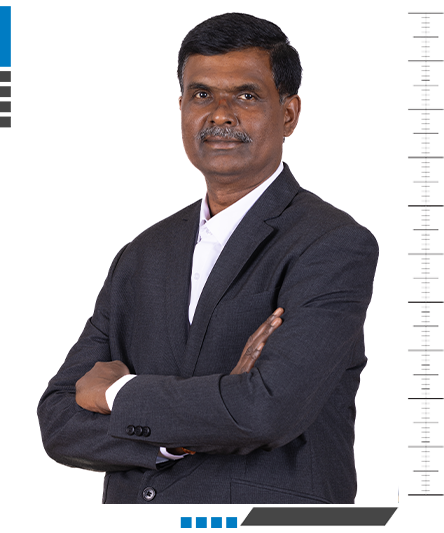
Message from HOD
Civil Engineering is the oldest branch of engineering and is the backbone of infrastructure and human well-being. From the buildings we live and work in, to the roads we travel on, and the systems that deliver clean water and manage waste, Civil engineering touches nearly every aspect of daily life.
Role of civil engineers has become both vital and challenging due to rapid urbanization, climate change and resource constraints. Civil Engineers are at the forefront of developing green infrastructure, smart cities, resilient disaster management systems, and advanced digital modelling techniques that shape the future of sustainable development.
The Department of Civil Engineering at RV College of Engineering is supported by experienced and highly qualified faculty members representing all major disciplines of civil engineering. Our laboratory infrastructure enable students to gain hands-on exposure to material, model testing, and to engage in innovative research. The department houses specialized facilities such as a Mini test Floor, workstations, fatigue testing machine, and DGPS. Faculty members are actively publish research papers in reputed national and international conferences and journals also provide industrial consultancy.
Both the B.E. and M.Tech. programs are accredited by the National Board of Accreditation and the department is recognised as research centre by Visvesvaraya Technological University (VTU), Belagavi, for conducting research leading to M.Sc. (Engg.) and Ph.D.
Emerging technologies are reshaping how we design, construct, and maintain the built environment—offering new tools, perspectives, and opportunities. The department emphasizes the integration of such technologies, including:
- Building Information Modelling (BIM): Enhancing design collaboration and visualization.
- Artificial Intelligence and Machine Learning: Optimizing construction processes, predictive maintenance, and structural health monitoring.
- Drones and Remote Sensing: Facilitating real-time site inspections and topographical surveys.
- 3D Printing: Accelerating construction speed and improving quality.
- Geographic Information Systems (GIS): Enabling advanced spatial analysis and urban planning.
- Digital Twins: Creating virtual replicas of physical assets for performance monitoring and informed decision-making in infrastructure management.
Emerging technologies will be offering new career opportunities such as Sustainable Infrastructure Engineer, BIM Specialist, Digital Twin Engineer, Smart City Planner, Construction Automation Specialist, Disaster Resilience Engineer, and Geo-Spatial Engineer in the future.
The department works diligently to equip students with the knowledge, technical expertise, and problem-solving skills required to excel in the profession through experiential learning and internships to make our students more competent, confident and future-ready.

Research
Industry Sponsored Projects
Consultancy
Address:
RV College of Engineering, RV Vidyanikethan Post, Mysuru Road, Bengaluru – 560 059
Principal’s Office
Dr. K.N. Subramanya
Principal
RV College of Engineering
Phone no:
+91-080-68188100 / 8111
principal@rvce.edu.in